DON’T GIVE IN TO FEAR (OR HOW TO TRAVEL TO A PLACE YOU KNOW NOTHING ABOUT)

DON’T GIVE IN TO FEAR (OR HOW TO TRAVEL TO A PLACE YOU KNOW NOTHING ABOUT)

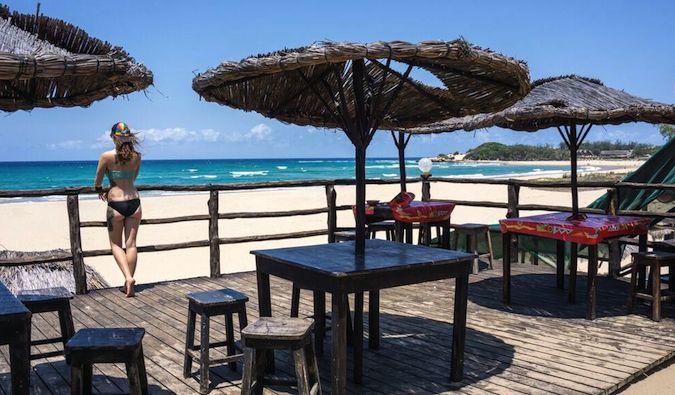
Woman at secluded beach paradise
On the second some Wednesday of the month, Kristin Addis from Be My Travel Muse writes a guest column featuring tips and advice on solo female travel. It’s an important topic I can’t adequately cover, so I brought in an expert to share her advice for other solo female travelers! Here she is with another amazing article!
I sat with my new friends on Thanksgiving night in Tofo, Mozambique. Our food was slow to arrive, so we decided to pay homage to the nature of holiday and talk about what we were thankful for.
In that moment, I couldn’t believe that I was surrounded by so many amazing people who had arrived here from various corners of the earth, all in the same way I had: by word of mouth. There were two blonde Californian girls here thanks to the Peace Corps, a cleverAussie brunet who had just finished some of his PhD studies in a town in the north, another American who had arrived on a whim and brought all the laughs with him, and a few others from North America and Switzerland. We were as happy and relaxed as could be. Each person’s giving of thanks was more beautiful and profound than the last, some even bringing tears to my eyes.
Just a few weeks before, I had been petrified of traveling through Mozambique. There were a lot of question marks, and I could find few answers online. I knew just a bit about the country from what my friends from South Africa told me: Mozambique is a formerPortuguese colony rebounding from a civil war that ended in 1992. It’s coastal, bordering South Africa’s east coast. It’s absolutely gorgeous, with seafood fresh out of the ocean for a few dollars, and long stretches of beaches with endless sand bars and baby-blue water.
But I also knew that Mozambique isn’t an easy country to travel through. The police officials are corrupt, and the buses used by the locals, known as chapas, are generally just vans with bald tires that can accommodate 20 people but squeeze in 40. There’s a bit of tourist infrastructure in a few key places, but beyond that, it’s full of bad roads and mysteries.

Friends on the beach standing in rays of light
Apart from warnings and scary statistics, there isn’t much information online about the country. While searching for accounts from solo female travelers, I stumbled on a forum on a scuba board from 2013 that advised a poster to think twice about going if she was good-looking. A posting in the Lonely Planet Thorntree forum that wasn’t much more encouraging; it linked to a blog post that stated that Mozambique was the toughest country the author had traveled through: she’d been robbed, it was too expensive, and she elected to cut her trip short. I started to wonder if I’d find anything positive at all.
Then I remembered something: There are a lot of misconceptions about Africa. People tend to think it’s a horribly dangerous place and forget that there are also kind people, beautiful landscapes, good food, and unique adventures to be found.
Similarly, before I went to South Africa for the first time, a few friends from back home expressed deep concern that I would be traveling through a country they perceived as too dangerous to traverse on my own. They warned me against Ebola (which hadn’t even come close to infiltrating South Africa), rape, and violence. In reality, I found that with the right precautions, traveling there was no problem and that fear is often more limiting than helpful.
Likewise, when it came to Mozambique, I knew that it was only irrational fear holding me back.

Beautiful sunset on the beach
And then I realized – traveling to a country there is little information about is the same as traveling to any other place!
You figure out the visa requirements (which I took care of in Johannesburg, South Africa, prior to going).
You make sure you have the right immunizations (which I took care of at a travel doctor in Johannesburg, who gave me antimalarial pills for much cheaper than they would have been in the US or Europe).
You ask when already on the ground for the best transport method. From Johannesburg, that’s an Intercape or Greyhound bus.
You ask locals at your first stop about where to go. The guys I couchsurfed with in Johannesburg delivered in spades when they told me to head to a beach town called Tofo.
You stay friendly and inquisitive upon arrival, and hold your head high and keep your back straight when asking questions and negotiating with taxi drivers and dealing with border crossing guards.
Traveling in Mozambique turned out to be just like traveling to every other place I had visited. I figured it out as I went, I was friendly and observant, and I asked locals and expats who had lived there questions whenever I got the chance. I realized that there was no reason to be worried – that I had done this a thousand times before in countless countries and cities around the world.
There were a few times I encountered dangerous situations. The chapas were so overpacked and dangerous that I resorted to hitchhiking to get around instead. It was actually the safer option!
And there were times when things just didn’t make any sense, such as when I had to go to the airport to book a flight out, simply because the online systems weren’t working. Once I got there, the employees had to work between three computers to actually book the ticket, since each was a bit broken but still worked for one aspect of the booking process. The ordeal took an hour and a half, but it was just the norm there.
So is ordering your food two hours before you want it, because it just takes that long. And a few friends of mine who drove a car had to pay a fine to the police because they had bags in the back seat and the “seats are for people, not bags.”

Friends buried up to necks in sand
Such is Mozambique. It’s frustrating and difficult in so many ways, yet it’s so breathtaking and full of smiles. I learned so much about the culture, humanity, and patience while I was there. I was let in in ways that just don’t happen in Europe or the US. People would invite me out to show me “the real Mozambique,” and I’d dance the night away and end up with a handful of new friends. Nowhere has been so challenging and rewarding all at the same time.
The bonus was that I made all of these discoveries on white-sand beaches with aquamarine waters full of whale sharks and devil rays. The cherry on top was that I was paying less than the equivalent of $30 per day for the privilege.
The country wasn’t that scary, and it certainly wasn’t expensive like the message boards led me to believe (Mozambique is the only country I’ve visited that didn’t charge me double for being a single girl in a private bungalow!). I was glad I didn’t let my overactive imagination and irrational fear win.
I know that traveling to somewhere you’ve never been before, with limited available information, can be extremely nerve-wracking. Compound that with the fact that I was traveling in “scary, scary” Africa, and it becomes even more daunting.
However, I was shown yet again that letting fear get in the way of what could be a wonderful travel experience is a mistake. I had a chance to meet an amazing crew, and most important of all, take on a challenge solo and dominate it. I had another chance to prove to myself that I’m capable, and that I still prefer solo travel, after all. I got to know a new country that few people visit intimately, and the good times far, far outweighed the bad, times ten. No, times a million. The same can happen for you

5 STEPS TO BOOKING A CHEAP FLIGHT ONLINE

5 STEPS TO BOOKING A CHEAP FLIGHT ONLINE

booking a flight online for cheapBooking a flight can be one of the most stressful parts about travel! Airfare is expensive and, with variation in prices, we often worry that if we buy right now, prices could drop and we’d be the person who paid the most money for the flight. “Maybe if I wait just a little longer, prices will drop,” we say to ourselves.
I used to spend hours upon hours searching for the right price. I’d search multiple websites, second-guess myself, and worry about what happens when the prices drop. I would hold off on buying, waiting for that perfect moment. It was like trying to time the market – it simply doesn’t work. 99 times out of 100, you lose out. On a recent trip from Austin, a one-way ticket on American Airlines was $206 USD. The next day it was $149 USD and a BETTER route. When I checked a few hours later, it was back to $206 USD.
You can’t predict prices. The best day to book is usually today.
Last year, I went to visit the folks at Google Flights, and over lunch they told me about a study they did of thousands of flights. They found the average drop price is about $50 USD. That means if you wait, you’re most likely to save about $50 USD but might be stuck with a price that is hundreds higher. (This excludes sales and mistake fares.)
As someone who doesn’t go a day without searching for airfare to regions all over the world, I can tell you that you can’t second-guess yourself. If you’re comfortable with the price you paid, you need to accept it and move on, even if airfare drops.
In the past, I’ve explained how to finding a cheap flight – the theory and strategy to use when searching for a flight. Today, I want to show you how to put that into practice and walk you through how I book my tickets.
For this article , I’m going to look for a flight from Sydney to Hong Kong or NYC toAthens in March for 8-10 days. (Note: Prices reflect the day of search on 11/11/15.)

Step 1

First, I’ll look at deal websites like Holiday Pirates or The Flight Deal to see if there are any fare sales going on. Sometimes there are, most of the times there aren’t.
After that, I start with the ITA Matrix, an amazing tool that allows for complex searching and that every flight junkie I know uses. While it only searches major airlines (no budget carriers here), it has a calendar option so you can see prices over the course of the month and provides a solid baseline on prices.
Sydney to Hong Kong:
NYC to Athens:
The cheapest flight to Hong Kong is $507 USD on China Airlines via Taipei for 10 days, though further research revealed a direct flight on Qantas for $524 USD. The cheapest flight to Athens was $698 USD on Turkish via Istanbul for 10 days (there are no direct flights).

Step 2

Next, I go to Skyscanner and Momondo to compare prices and see if there are any budget carriers flying the route I need.
Sydney to Hong Kong on Skyscanner:
Sydney to Hong Kong on Momondo:
Both of these search sites brought up a much cheaper flight on the budget airline Scoot. You’ll also notice Momondo brought up a cheaper SYD-HKG ticket on the same flight. That’s another reason to check multiple booking sites. You might find a cheaper price for the same flight elsewhere!
NYC to Athens on Skyscanner:
NYC to Athens on Momondo:
With the NYC flights, both Skyscanner and Momondo returned the Turkish Airways flight, though Momondo prices it cheaper at $657 USD.

Step 3

Next, I visit Google Flights to search regional fares. For example, if I’m flying to Athens, I’ll see what flights to nearby airports might be cheaper. It may be cheaper to fly intoParis and take a budget airline to Athens. Though you’ll end up booking two different tickets on two different airlines, you can sometimes save hundreds of dollars. I booked a flight to Dublin and then flew Ryanair to Paris, saving me $200 USD instead of taking a direct flight.
On the Sydney-to-Hong Kong route, there are not a lot of alternative airports to choose from, so the $340 USD on the budget airline Scoot is the cheapest option we would find.
However, for NYC to Athens, we have plenty of options, since there are a lot of airports and budget carriers in Europe to choose from. (Pro tip: If you aren’t a junkie like me and know which budget airlines fly where, visit the airport’s website to get a list of airlines.)
Looking at Google Flights, the cheapest flight is $725 USD with two stops, worse than what Momondo returned! However, leaving and returning two days later (I’m flexible) brings up a $605 USD flight via Kiev:
That’s a big improvement. Next, I zoom out and look at the region. I see that leaving on the 6th there’s a $416 USD flight to Stockholm and then another $168 USD flight to Athens. Though this saves $21 USD, when you factor in immigration, checking into a new airline, possible delays, and your time, it’s not worth it. This doesn’t produce anything cheaper without extremely long layovers. I don’t believe saving $21 USD is worth an extra 20 hours in an airport. Though I have used this method to save money in the past, in this case, booking two separate flights isn’t worth it so I move on.

Step 4

After looking at these three websites, I may look at Kayak or Orbitz just as a safeguard. It doesn’t take long to enter in a few dates and if the prices they return are similar to what I got before, I close out the browser and move on.
Next, I’ll visit the airlines’ websites to see if there are any cheaper deals to be found. In order to encourage consumers to book directly with them, airlines often have cheaper prices listed on their website. For Scoot, the price wasn’t cheaper. With Ukraine International Airlines, the price came up a lot cheaper:
You may wonder why I didn’t just go to the airline directly. Because the airlines don’t always have the cheapest flight. In this case they did but on the flight I just booked to Laos, Laos Airlines’ website was $50 USD more than what Momondo returned!

Step 5

After booking the flight, I make a note to check back in 23 hours as you have 24 hours to cancel a flight without penalty, so right before that time is up, I’ll clear out my browser’s cookies and do a quick search to see if the price dropped (see my Austin example above). I’ll either rebook or keep my flight based on what I find.
After that, I don’t give a second thought to it, even if two weeks later there’s a sale or I see a cheaper price pop up somewhere. You can’t know the future or when a sale will come. You can only make your best decision with the information at hand at the very moment you’re booking.
Maybe you’ll spend 10 hours searching to find some obscure website that is $5 USD cheaper. Maybe your flight will become $200 USD cheaper the next day. Maybe there will be a sale. Maybe the price will go up! In the end, it is not worth worrying about. First, you’ll be frozen with potential buyer’s remorse if you worry about future prices. You’ll never buy a flight because you’ll always be wondering “what if?” and, in the end, you’ll wait too long — and probably pay more. Second, how much is your time worth? Maybe I could search more, but I’d rather use those extra hours to enjoy life, plan a tripwork on my blog, or relax at the beach. My time is more valuable than a slight drop in price will ever be.
If you’re spending more than an hour booking a flight, you’re spending too much time. This entire process from start to finish took me 40 minutes. After that, I went back to watching Narcos on Netflix. I never second-guess myself on flights. You’ll go crazy if you do. Spend 30-40 minutes finding and booking a cheap flight at a price you’re OK paying (Still too much money after all of this? Go somewhere else), and move on with your life.
JOINING A FREQUENT FLYER PROGRAM

JOINING A FREQUENT FLYER PROGRAM

A jet airplane flying in the airBack in 2008, I joined my first frequent flier program. Despite having traveled around the world for close to two years, I never saw the value in signing up for one – I’d always been more concerned with price than brand loyalty, so I switched networks and carriers all the time. The lowest price always won.
Another reason I had never signed up before? All my favorite carriers are spread out over different alliances. Japan Airlines (JAL) is on the Oneworld network, while Singapore is on Star Alliance. Emirates Airline, the carrier that makes me salivate the most, isn’t on anyof these networks.
Yet back in 2008 I realized that as I was going to fly around the world more, blogging as I went, it was probably a good idea to join an airline alliance – racking up miles, earning upgrades, and getting lounge access was probably a good idea for someone who was going to be in an airport every few weeks.
Over the years, I’ve been a member of all the alliances and my opinion about these programs has changed since I first wrote about them in 2008. Last year, I wrote about why people should not be members of frequent flier programs. Sure, you should always sign up for the program to get the points, but if you aren’t flying enough to hit elite flier status, then you should base your decisions on price. Go with the lowest price and when you do get miles, exchange them for a free flight.
But if you do think you are going to fly enough to make it worth it, you should totally join a frequent flier program. The lowest tiers in the program, while not great, usually start at 20,000 flown miles.
You can read a lot of opinions on which program to join. Some people will say to join them all, others will tell you to join the ones with your favorite carriers, and others believe you should join the one with the major airline in your home town. I’m of the last opinion. The right alliance to join is the one on which you will most likely earn elite status.
This year I switched from Oneworld to Star Alliance. I did so because I was supposed to move to Europe and the major airline out of Stockholm is SAS, a Star Alliance member. But now that I’ve moved back to the States? I’ve switched back to American, a Oneworld carrier, because they have a hub at JFK and I like them better than United, who is part of Star Alliance.
I strongly recommend that if you are going to be traveling a lot, you stick to one alliance and earn elite flier status. Your status will last 14 months, so even if you don’t fly a lot the following year, you can still reap the benefits for a little while longer.
Because there is nothing like seeing the line for security check-in and realizing you can whiz right on past it or sit in a comfortable lounge with free drinks to make the flying experience infinitely times better.
WHY YOUR AIRPLANE TICKET IS SO EXPENSIVE NOWADAYS

WHY YOUR AIRPLANE TICKET IS SO EXPENSIVE NOWADAYS

Expensive airplane underbelly while a plane is in the airA few months ago, I was speaking with a representative of Singapore Airlines, and we ended up talking about the public perception of airfare costs. Everyone is always looking for the cheapest flight. And while there are ways to get cheaper airfare, the age of rock-bottom prices is simply over. If you’ve been flying for at least the past few years, you might have noticed that ticket prices, even the cheapest ones, are going up and up. Save some flash sale or price war, consumers are just paying a lot more than they used to. If you really want rock-bottom prices, you’ll need to invent a time machine and go back 10 years. (Don’t forget to take me with you!)
That conversation inspired me to sit down and write this post. Since ticket pricing is a complicated and arcane subject, I want to take some time to explain why your airline ticket costs so goddamn much, as well as share a few tips on how to still get cheap airfare.

Why Have Prices Increased?

Ticket prices are high today for a number of reasons. For starters, the industry has consolidated a lot over the last few years. Less competition means less need for cheaper prices. Thanks to bankruptcies and mergers, there are now only four major airlines in the United States (soon to be three when American merges with US Airways). In Canada, there are two. In Europe, KLM and Air France are now one company, and Lufthansa has its hands in many smaller airlines. (While budget airlines keep prices cheap within Europe, once you leave the continent, those 10 euro prices disappear!) As airlines have partnered up, merged, or gone bankrupt, the incentive to create low fares to win your business has mostly disappeared.
Secondly, the price of airline fuel has increased tremendously. Back in 1996, airline fuel cost 55 cents per gallon. Now, it’s $2.97 per gallon. Airlines can’t absorb all of that increase, so they pass some of that on to the consumer, leading to higher fares.
Additionally, airline taxes and security fees have increased, adding a lot to your base fare. Currently, the following fees are added to the cost of your ticket:
  • September 11 Security Fee of $2.50 (up to a maximum of $10 per round trip)
  • Passenger Facility Charge of $4.50 per segment (up to a maximum of $18 per round trip)
  • US Federal Domestic Segment Fee of $3.70 per segment
  • US Travel Facilities Tax of $8.20 per direction (only applicable to flights to/from Alaska and Hawaii and the 48 contiguous US states or between Alaska and Hawaii)
  • US Immigration User Fee of $7
  • US Customs User Fee of $5.50
  • US APHIS User Fee of $5
  • US International Transportation Tax of $16.30 per arrival or departure
  • Foreign government security/tourism/airport/international transportation taxes and fees of up to $290 (vary widely by destination and fluctuate with exchange rates)
That’s a hell of a lot of fees! And it’s not just the United States. Ever fly into London? Half the ticket price is made up of fees and taxes!
Moreover, following 9/11 and the recession, demand fell, and to compensate, airlines reduced both the number of routes they offered and the frequency of their flights. They did this to save money and fly fuller planes. Fuller planes mean more passenger revenue and fewer costs for the airline. It’s why if you live far from a major city, you’ve seen fares go up and the number of flights go down. Planes fly close to full now, and airlines are quite happy about that.
With fewer planes, less competition, and higher capacity, airlines can charge a lot more for tickets. There’s nothing to stop them, and they don’t need to lower prices. United CEO Jeff Smisek said that only now are airfares priced appropriately. When you have a CEO say something like that, it means prices aren’t going down anymore — only up.
According to Rick Seaney of Farecompare.com, “Before 2008, things were in the favor of the passengers. After the 2009 crisis, the scale of justice tipped towards the airlines.”

Why Do Prices Fluctuate?

Prices go up and down for many reasons. No one can really predict when or if a price will change. Only the airline knows that. But there are four things that drive prices: competition, supply, demand, and oil prices. The first and last items are the ones that really affect prices the most.
Together, those four things all affect a lovely thing called the load factor. Airlines want to fill their planes and maximize profits, and they do this by calculating a plane’s load factor. Essentially, this is the percentage of seats sold on a flight. They want this number to be as high as possible.
Airlines tend to manage their load factor by constantly changing the price of tickets to fill the plane and get maximum revenue. On a US domestic flight, there might be 10–15 different price points, according to Rick Seaney.
If the load factor is low and demand is low, an airline will increase the availability of cheap fares. If the load factor is high and demand is high, the airline will raise prices.
In the airline industry, there are two types of passengers: business travelers and leisure passengers. Business travelers are flexible on price (the boss is paying) but not on dates. Leisure travelers aren’t flexible on price (the cheaper, the better) but are on dates. Airlines are constantly trying to strike a balance between these two types so they can make a profit. Why fly a plane full of cheap fares when you can get people to pay more?
Airlines know that a certain number of people will book far in advance if they can find a decent price. Airlines also know that they need to hold a certain number of seats for business travelers who will book last-minute and pay more. Ticket prices jump up and down based on the demand for seats from these two types of passengers.
As Scott Mayerowitz, airline reporter for the Associated Press, says, “To maximize their profit, airlines developed sophisticated computer systems that constantly compare booking trends to past sales history. If tickets are selling faster than in the past, the price rises. If a competitor raises fares, the airline will probably raise theirs too.”

How Do You Get Cheap Fares?

I remember the days when I got excited over $500 fares to Europe. Now, with prices typically around $1,000, I get excited over $750 round-trip fares. (“Yay!” I say sarcastically.)
It’s not impossible to find a cheap ticket. There are many, many ways to find cheap airfare, and while I go into incredible detail in this other post, here are some basic pointers:
To avoid being the person who paid the most for their ticket, you need to be flexible. As I said, airlines are constantly changing prices and trying to balance leisure and business travelers; they’ll do their best to avoid having customers pay the lowest price point.
“About three months before, airlines start to manage those bottom price points,” Rick says. That means airlines begin to look at historical trends and current seat sales to figure out whether they will release those really rock-bottom fares or keep prices high.
If you’re booking inside a month, you’re playing into the airline’s hand. As Rick pointed out to me, most tickets are sold within 30 days of departure. Booking that late is a bad idea. At that point, airlines know they have you. When your dates are no longer flexible, you’ll pay whatever they charge.
To quote Scott again: “The days of routinely flying from New York to San Francisco for $99 each way are long gone. That said, there are occasional fare wars when airlines like Virgin America or Spirit enter a new market. Airlines will also still deeply discount flights when traffic is low, such as winter flights to Europe. The catch is: travelers need to be flexible about when they fly. ITA Software’s airfare search provides a calendar of the lowest fares on given routes. It’s a great way to find the best fares, if you have some flexibility.”
(For more tips from Scott, check out my interview on airlines with him.)
And while there are many other tricks to reduce the cost of your ticket, the main two are flexibility and flying when demand is low. That means flying mid-week, taking early-morning or late-night flights, and avoiding flying on Monday, Friday, or Sunday.
The days of cheap airfares are long over. They aren’t coming back, and the prices you see now are the new normal for airline tickets. They are simply going to cost a lot more, especially if you don’t find the sweet spot when prices are their lowest. But by understanding how tickets are priced, you can avoid being the person who paid the most.
HOW TO FIND A CHEAP HOTEL ROOM: SITES TO USE AND SITES TO AVOID

HOW TO FIND A CHEAP HOTEL ROOM: SITES TO USE AND SITES TO AVOID

how to find a cheap hotel roomAs much as I love hostels and other forms of cheap accommodation, there is something nice about the luxuriousness of hotels. They are clean and quiet and feature comfy beds, strong showers, and lots of soap I can take for later.
But luxury comes at a price. Hotels certainly aren’t cheap, and I hate spending a lot of money for a room I am only going to be in for a few hours. It’s why I mostly avoid hotels — I don’t think they are a good use of money (and there are far better accommodation options out there). If I’m not in a hostel, you can usually find me at a cheap guesthouse or at an Airbnb.
But I’ve been traveling a lot for “work” lately (conferences, speaking gigs), and with the seemingly endless hotel booking sites out there, I decided this was a good time to do some testing and find out which sites offered the best deals.
I also picked five cities to research: London, Los Angeles, Paris, NYC, and Seattle. I picked stays close to the current date of research and then far in advance, on both weekdays and weekends. (I did my research end of March, which is why the dates are different than what you’d expect from a post published in early May.)
I searched six booking websites: ExpediaHotels.comBooking.comHotwire,Priceline, and a new one called TravelPony in 2-, 3-, and 4-star categories. Below are the data tables with the lowest price shown (Priceline rates are based on their search listings, not the bidding section of the site). You can also just click here and jump down to my analysis if you don’t want to look at the tables.

Seattle, WA

3/28-3/30

ExpediaHotelsTravelPonyBookingHotwirePriceline
2*$45$45$-$59$46$48
3*$74$74$-$119$63$74
4*$143$143$-$179$143$142

4/1-4/3

ExpediaHotelsTravelPonyBookingHotwirePriceline
2*$43$43$-$59$50$42
3*$81$81$75$87$79$81
4*$185$179$127$149$137$159

4/25-4/27

ExpediaHotelsTravelPonyBookingHotwirePriceline
2*$42$42$113$59$42$42
3*$76$76$-$89$63$75
4*$143$143$-$149$143$142

4/29-5/1

ExpediaHotelsTravelPonyBookingHotwirePriceline
2*$42$42$101$59$42$42
3*$81$81$75$87$69$81
4*$186$186$127$149$186$179

New York

4/25-4/27

ExpediaHotelsTravelPonyBookingHotwirePriceline
2*$184$159$215$169$159$145
3*$251$212$119$171$180$170
4*$242$230$85$186$186$186

4/29-5/1

ExpediaHotelsTravelPonyBookingHotwirePriceline
2*$195$127$127$139$170$126
3*$234$197$135$195$197$188
4*$245$206$167$206$251$206

3/28-3/30

ExpediaHotelsTravelPonyBookingHotwirePriceline
2*$149$134$215$128$159$120
3*$201$134$119$149$161$152
4*$214$184$239$161$176$161

4/1-4/3

ExpediaHotelsTravelPonyBookingHotwirePriceline
2*$127$95$127$99$107$118
3*$135$102$135$119$160$138
4*$149$149$167$153$152$136

Los Angeles

4/25-4/27

ExpediaHotelsTravelPonyBookingHotwirePriceline
2*$48$48$61$53$58$45
3*$76$76$55$79$88$95
4*$125$125$99$108$109$134

4/29-5/1

ExpediaHotelsTravelPonyBookingHotwirePriceline
2*$47$45$61$47$50$43
3*$84$79$79$65$88$109
4*$152$152$89$98$151$161

3/28-3/30

ExpediaHotelsTravelPonyBookingHotwirePriceline
2*$48$50$79$54$58$45
3*$76$76$52$80$88$107
4*$119$119$-$109$109$119

4/1-4/3

ExpediaHotelsTravelPonyBookingHotwirePriceline
2*$48$48$63$49$50$45
3*$84$84$55$65$88$109
4*$153$172$112$129$150$172

London

4/25-4/27

ExpediaHotelsTravelPonyBookingHotwirePriceline
2*$51$45$-$112$47$67
3*$54$58$59$147$74$74
4*$75$110$-$196$82$118

4/29-5/1

ExpediaHotelsTravelPonyBookingHotwirePriceline
2*$50$51$-$107$47$63
3*$64$93$105$142$64$70
4*$103$110$-$152$107$108

3/28-3/30

ExpediaHotelsTravelPonyBookingHotwirePriceline
2*$47$58$-$103$47$57
3*$67$62$55$145$68$70
4*$100$81$-$126$81$107

4/1-4/3

ExpediaHotelsTravelPonyBookingHotwirePriceline
2*$50$50$-$85$62$54
3*$54$68$63$88$85$58
4*$75$117$-$107$102$88

Paris

4/25-4/27

ExpediaHotelsTravelPonyBookingHotwirePriceline
2*$44$44$-$140$58$36
3*$49$51$83$173$61$56
4*$69$69$157$206$106$86

4/29-5/1

ExpediaHotelsTravelPonyBookingHotwirePriceline
2*$53$52$-$148$69$43
3*$60$50$75$158$87$68
4*$75$75$-$204$118$92

3/28-3/30

ExpediaHotelsTravelPonyBookingHotwirePriceline
2*$44$45$-$117$58$40
3*$57$50$89$143$74$59
4*$88$69$129$172$116$85

4/1-4/3

ExpediaHotelsTravelPonyBookingHotwirePriceline
2*$44$52$-$144$82$50
3*$62$66$102$142$93$86
4*$93$141$169$178$165$119
So what can we learn from this data? Is one site better than the rest?
I went into this experiment with the assumption that Hotels.com and Expedia would have the most expensive rates and Hotwire would be the cheapest (casual searches in the past had led me to believe this). TravelPony has shown a lot of promise, but they are new and have limited inventory (sometimes they returned zero listings), so I didn’t have great expectations for them.
But the data proved my theory wrong.
a nice hotel roomFirst, when TravelPony had availability, they usually won, especially in the 3- and 4-star categories. They blew the competition right out of the water. In many instances, they are substantially cheaper than their competitors.
Why? Well, for that, let’s step back for a moment and talk about why prices are what they are. Hotels have a variety of rates: prepaid, flexible, corporate, discounted, and more. And while rates go up and down based on demand, they don’t (luckily) swing as widely as airline prices. They are a bit more static.
Hotels sell rooms to these booking sites at a discount, which is why you often see rates cheaper on these sites than on the hotel’s website (more on this in a bit). The big booking companies then price in their costs, marketing, and whatever else to come up with a base for their displayed price. TravelPony doesn’t do that (according to the CEO, as I asked why his rates were so low in an interview). They simply rely on word of mouth. Plus, they require you register to see the hotel prices, thus falling into a “club” category that allows them to give cheaper rates. They are getting the same rates as the big booking sites but don’t need to increase their price as much.
As for the other websites, Expedia and Priceline were the cheapest in 17 instances while Hotwire was in only 10. Hotels.com was the cheapest in 13 instances.
The clear loser was Booking.com, which only offered the cheapest rate in 3 instances.
Note: If there was a tie, both booking sites were counted as having the lowest price.
But those overall numbers mask a lot of variance. In the same city, depending on hotel class, we could have a different winner each time. TravelPony was the winner in the US and in higher-class hotels while Priceline was great for 2-star hotels, Hotwire for 3-star, and Expedia dominated London and Paris.
Note: This past weekend I did another round of testing and even added in two new cities: San Francisco and Rome. The results were pretty much the same, though Booking.com tied with Priceline in 2-star hotels in San Francisco, regardless of date.
Before I go into what this means for the booking process, it is important to remember that when you book hotels via third-party websites, you don’t earn hotel points or status for your stay. In order to get that, you must book directly with the hotel. And this is why these online booking sites can offer cheaper prices. In exchange for that, hotels make them give up their customer’s right to award and elite status eligibility (also, their massive purchasing power helps).

Three Final Websites

Before we go into the booking process, let’s bring up three final websites:
First, what about those meta search sites like Trivago or Hotelscombined? Hotelscombined claims to search thousands of websites (including hostel booking sites) but my cursory searching showed that they didn’t return as many cheap places as they say they will. They showed a cheap 3-star room in downtown London in June for $134 per night, but Expedia came back with $91. And they often didn’t show more than just a couple of websites. I’d skip them.
I would AVOID Trivago. My research showed that they consistently overrated their hotel listings. A four-star hotel on their site was listed as a two- or three-star hotel (or a three-star was a one-star) on the site they took you to for the actual booking process. This was consistent over numerous cities and dates. Here’s a screen shot to illustrate the point:
On Trivago:
bad trivago listings
When I went to Priceline:
normal priceline listings
They also rated a hostel in NYC as four stars (no hostel is ever four stars). I didn’t catch it the first couple of times, but when I did, I was shocked. Because Trivago sends you right to the booking page on another website, this change of class would be easily missed by consumers. You might end up in a two-star hotel when you wanted a four-star. I don’t think they are intentionally misleading people, but the error occurred often enough where I wouldn’t trust Trivago and will say you absolutely shouldn’t use them.
Finally, let’s talk about Tingo. Tingo is a website that refunds your money if the price of your hotel room falls after you book it. It’s a wonderful way to ensure you don’t have to worry about getting screwed. Before I booked anything, I would check your hotel’s price on this website to see if it is lower or equal to the prices you found on the other search sites. If it was, I would book here to take advantage of their price-drop offer. You can’t go wrong with them.

How to Book a Hotel

Hotel pricing is a lot more set than airline pricing and tends to fluctuate less. I wouldn’t spend hours searching hotel websites or days tracking prices like people do with airline prices.
I would start with your preferred site (for US hotels, I’d make that TravelPony), search two or three other websites, and then check the hotel’s website (don’t forget to call — hotels often match rates). I’d spend, at the max, 30 minutes on booking a hotel. I found that the variation between sites isn’t enough to justify spending hours looking for a deal. At the end of the day, wasting hours of your life isn’t worth trying to save a dollar or two. Moreover, many larger booking sites have their own loyalty reward programs and, if you consistently use one site, the rewards might be worth it to stay with just one site, even if it isn’t the cheapest option.
For me, booking a cheap hotel looks like this:
  1. Start off with Priceline, Expedia, TravelPony, or your favorite booking site. (If you are booking in Asia, use Agoda. They are hands down the best site for the region.)
  2. Double-check a few more sites just to cover your bases.
  3. Skip the poor sites mentioned here.
  4. Cross check with Tingo.
  5. Book a place.
  6. Go on with your day.
Don’t spend hours searching for a hotel room. My research showed prices don’t fluctuate that much, so it’s not worth the time to do so. Follow the steps above, get a great cheap room, and enjoy your trip.